Structural Drying and Dehumidification in Denver, CO
24/7 structural drying in Denver. Dehumidifiers and air movers are sized to the class of loss, and framing, subfloors and concrete are dried against readings until they reach a dry reference.
(888) 532-8620Walls still wet? Call now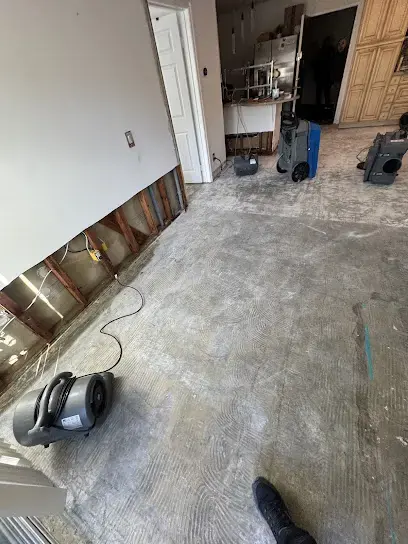
First steps for structural drying and dehumidification in Denver
- 01
Extract first
Standing water has to be removed before drying equipment can work on what is inside materials.
- 02
Keep doors and windows shut
A closed space lets dehumidifiers pull moisture without taking on outside air.
- 03
Leave equipment running
Turning units off early leaves moisture in framing, which can bring swelling and odors.
- 04
Let readings decide
Daily readings, not the feel of a wall, show when the dry goal is met.
How structural drying and dehumidification is handled in Denver
Drying is a measured process, not a matter of turning on fans. After extraction, the water that remains lives inside framing, subfloor and concrete, and removing it takes the right equipment run for the right number of days.
What does structural drying and dehumidification cost in Denver, CO?
Structural drying in Denver commonly runs $1,000 to $3,500 for one or two rooms and $3,500 to $9,000 for a basement or several rooms, depending mostly on equipment count and drying days.
One or two rooms
- Small wet area
- A few units for three to five days
- Readings logged daily
Basement or several rooms
- Larger wet volume
- More dehumidifiers and air movers
- Framing and slab dried
Class 4 dense materials
- Concrete, plaster or hardwood
- Desiccant units and mats
- Longer drying time
Ranges are typical, not a quote: the water category, square footage, material class and how fast drying started move the number most. Run the water damage cost calculator for a closer range.
The structural drying and dehumidification process, start to dry
The tech who does the walkthrough maps moisture before any equipment goes down, so the drying plan matches what is actually wet.
- 1
Classify the loss
The tech sets the class and sizes equipment to the wet volume.
- 2
Place the equipment
Dehumidifiers and air movers go where evaporation is heaviest.
- 3
Read every day
Temperature, humidity and moisture readings are logged daily.
- 4
Remove at the goal
Equipment is taken out room by room when materials reach the dry reference.
Sizing the equipment
The technician classifies the loss by how much of the structure absorbed water and how porous the materials are. That class sets how many dehumidifiers and air movers go in each room, and the count is recalculated when the rooms change.
LGR dehumidifiers handle most losses. Desiccant units take on dense or cold materials such as concrete, where an LGR unit runs out of pull.
- Air movers aimed along walls and floors
- Dehumidifiers matched to the wet volume
- Floor mats on hardwood and sealed floors
Dry air outside, wet materials inside
Denver's cool, semi-arid climate brings generally low humidity, but opening a house to that air does not dry a slab. Water inside concrete and studs moves out slowly, so a closed, controlled space with dehumidifiers dries faster than open windows. The equipment is placed where meters show the heaviest load, then moved as those areas dry.
After extraction in water extraction, drying takes over. A flooded lower level continues under basement flooding cleanup.
Soil and structure
Expansive clay soils swell when wet and shrink when dry across Colorado, and the Colorado Geological Survey says single-family homes built on a minimal budget are especially exposed. Controlling moisture inside a structure is part of keeping it stable, which is one more reason drying runs to a measured goal and not to a guess.
Trade fact: Drying is complete when materials sit within 2 to 4 points of a dry reference, not when the surface feels dry.
Structural drying and dehumidification across Denver and nearby areas
The Denver crew sets drying equipment in homes and buildings from LoDo and Five Points to Park Hill, Virginia Village, Central Park and Globeville, then returns for readings until the job is dry.
The same service nearby: structural drying and dehumidification in Commerce City, Glendale, Federal Heights.
Water damage restoration in Denver · every neighborhood covered
Related water damage services in Denver
Structural Drying and Dehumidification questions in Denver, CO
Still dealing with it?
Keep doors shut and the equipment running. Denver dispatch runs 24/7.
(888) 532-8620Start Denver structural dryingWhat does structural drying mean?
It is drying the building itself, meaning framing, subfloor and concrete, with dehumidifiers and air movers until readings reach the dry goal.
How long does drying take?
Most clean-water losses dry in three to five days. Dense materials and concrete take longer.
Why not just open the windows?
Outside air does not draw water out of studs or concrete. A closed space with dehumidifiers controls moisture much better.
What is the IICRC S500 standard?
It is the trade's drying standard. It sets water categories, classes of loss, equipment sizing and the dry goal.
Does low humidity make drying easier?
It helps upstairs rooms. Slabs and cold basements stay damp, so equipment and readings still decide when a job ends.
Why are readings logged daily?
They show whether drying is on track and give the adjuster proof that materials reached the dry goal.
Walls or floors still wet in Denver?
Measured drying with daily readings, from set-up to the dry goal.
(888) 532-8620Call about Denver drying