Structural Drying and Dehumidification in Commerce City, CO
24/7 structural drying in Commerce City. The drying team sizes dehumidifiers and air movers to the class of loss and dries framing, subfloor, drywall and slab until the readings match a dry reference.
(888) 532-8620Need the structure dried? Call now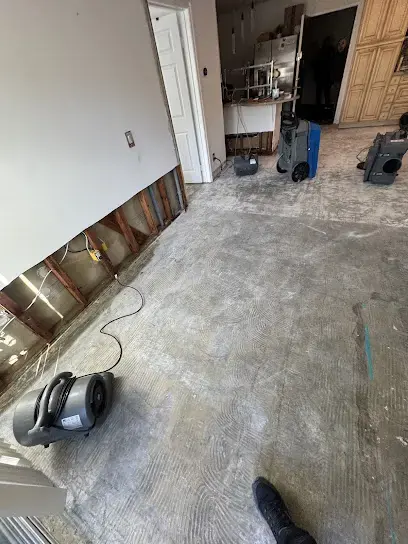
First steps for structural drying and dehumidification in Commerce City
- 01
Stop the water
The source has to be off or repaired before drying can finish.
- 02
Remove standing water
Extraction comes first; dehumidifiers are not meant to remove standing water.
- 03
Keep the area closed
Close doors and windows to the drying area unless the drying team says otherwise.
- 04
Leave equipment running
Turning off dehumidifiers or air movers resets the clock and adds days.
How structural drying and dehumidification is handled in Commerce City
Structural drying is the part of water damage restoration that decides whether a home stays sound. Surface drying makes a floor look dry; structural drying gets water out of framing, subfloor, drywall and concrete. The drying team works to the IICRC S500 standard and finishes when readings say so, not when the calendar does.
What does structural drying and dehumidification cost in Commerce City, CO?
Structural drying in Commerce City typically runs $1,000 to $3,500 for one or two rooms and $3,500 to $9,000 for a basement or several rooms, depending mostly on equipment count and drying days.
One or two rooms
- Class 1 or 2 loss
- Three to four drying days
- Readings logged daily
Basement or several rooms
- Class 2 or 3 loss
- More units, more days
- Slab and framing dried
Class 4 dense materials
- Concrete, hardwood, plaster
- Desiccant dehumidifiers
- Longer drying cycle
Ranges are typical, not a quote: the water category, square footage, material class and how fast drying started move the number most. Run the Commerce City water damage cost calculator for a closer range.
The structural drying and dehumidification process, start to dry
The tech who does the walkthrough maps moisture before any equipment goes down, so the drying plan matches what is actually wet.
- 1
Moisture map
The tech maps every wet material and picks a dry reference.
- 2
Equipment setup
Dehumidifiers and air movers are sized to the class of loss.
- 3
Daily monitoring
Readings and psychrometric data go in the log every day.
- 4
Pull at goal
Equipment comes out when materials reach the dry reference.
Sizing the equipment
The class of loss sets the equipment. Class 1 is a small, contained area; Class 2 is a whole room with wet carpet and walls; Class 3 is water from above with wet ceilings and walls; Class 4 is dense materials like concrete, hardwood and plaster that hold water deep inside.
LGR dehumidifiers handle most losses. Desiccant dehumidifiers come in for Class 4 materials and cold basements, where LGR units slow down. Air movers are set to the evaporation load of each room.
- LGR dehumidifiers for most losses
- Desiccant units for concrete and cold spaces
- Air movers aimed along walls and under cabinets
- Cavity drying systems for wet walls
Readings, not guesses
Every day the tech records temperature and humidity inside and outside the drying area, plus moisture readings at mapped points. The goal is materials within 2 to 4 points of a dry reference material of the same kind in the same building.
That log is what an adjuster reads. It shows the loss was dried correctly and explains every day of equipment.
Drying in a dry climate
Commerce City air is dry most of the year, which helps upstairs. Basements on a slab stay cool and damp, so they still run on dehumidifiers. Colorado State University Extension covers the local climate and home care, and the EPA WaterSense program covers finding the leaks that start it all.
- Daily psychrometric readings
- Moisture map updated as areas dry
- Equipment removed room by room at goal
Trade fact: a dry reference is a matching material in an unaffected part of the same building, so the goal fits that home, not a generic number.
Structural drying and dehumidification across Commerce City and Adams County
The Commerce City restoration crew covers ZIP 80022 and 80037, from the older Derby blocks near Highway 2 to the newer northern-range neighborhoods of Buffalo Run, Reunion and Second Creek.
Nearby coverage reaches Denver, Thornton, Northglenn, Federal Heights, Glendale.
See every Commerce City neighborhood and nearby area covered
Related water damage services in Commerce City
Structural Drying and Dehumidification questions in Commerce City, CO
Still dealing with it?
Leave the equipment running and call with any question. The drying team runs 24/7.
(888) 532-8620Get the framing dried to targetWhat is structural drying?
Drying the building materials themselves, framing, subfloor, drywall and concrete, not just the surfaces, to a measured goal.
How do you know when it is dry?
When materials read within 2 to 4 points of a dry reference material of the same kind in the same building.
Why is the equipment so loud?
Air movers and dehumidifiers move a lot of air. Turning them off adds drying days, so they run around the clock.
What is the difference between LGR and desiccant dehumidifiers?
LGR units work well in normal room conditions. Desiccant units pull water from cold spaces and dense materials like concrete.
How much electricity does drying use?
Each unit draws about as much as a household appliance. Some insurers reimburse the added power cost; check with your own insurer.
How long does structural drying take?
Three to five days for most losses, longer for Class 4 materials. The drying time estimator gives a typical range.
Wet structure in Commerce City?
Dehumidification, air movement and daily readings around the clock until it reads dry.
(888) 532-8620Call the drying team