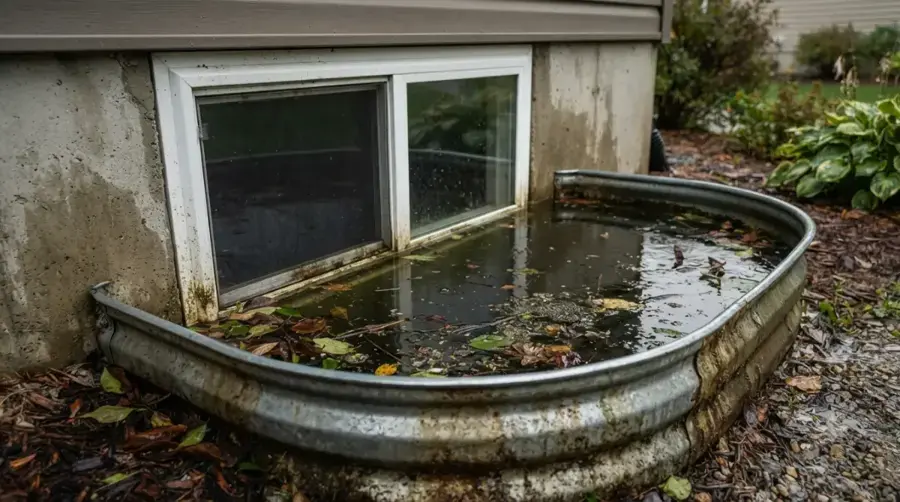
A window well is a small hole in the ground that holds a very large amount of water when it fills. In Commerce City, heavy wet spring snow that melts fast and summer cloudbursts are the usual causes.
Key takeaways
- Heavy wet spring snow melts fast along the Front Range, and cloudbursts add more water in summer.
- A full window well can push water through a basement window, the frame or the seal around it.
- Expansive clay soils around a foundation can leave gaps that let water collect near the well.
- Water from a window well often carries mud and debris, so it is treated as contaminated.
- Extraction and drying should reach the wall and the slab near the window, not only the carpet.
Why window wells fill in this climate
Commerce City is semi arid, but the water that does arrive tends to arrive fast. Heavy wet spring snow can melt in a matter of days, and cloudbursts can drop a lot of rain on the same ground.
A window well sits below grade, which makes it a natural collection point.
- Melting snow runs toward the lowest point near a foundation.
- A cloudburst can send more water than the soil can absorb.
- A well that is clogged with leaves, dirt or snow cannot drain.
- Soil that has shrunk away from the foundation can let water settle beside the well.
What clay soil has to do with it
Expansive clay soils are common along the Front Range. They swell when wet and shrink when dry.
Around a window well, that movement can leave gaps or a soil surface that slopes the wrong way, sending water toward the opening.
Wet soil swells
Soil that has absorbed water presses against the foundation and the well. Water that cannot soak in runs along the surface to the nearest low point.
Dry soil shrinks
In dry weather the soil pulls back and cracks open. The next storm then finds a ready path along the foundation.
How water gets inside
A window well is meant to hold back soil, not water. When it fills, the water has a few ways in.
- Over the sill and through a window that is not fully sealed.
- Through the frame or the seal around the window.
- Through a crack in the foundation wall near the well.
- Through a drain at the bottom of the well that has become blocked.
What to do when water pours in
A sudden flow through a basement window is stressful. Keep the response steady and focus on safety first.
- Stay out of the room if water is deep or touching outlets, and turn off power to that area if it is safe to reach the panel.
- Move furniture and belongings away from the wet wall.
- If it is safe, clear the window well of debris from outside, and do not open the window further.
- Photograph the well, the window and the water inside.
- Contact a restoration crew promptly for extraction.
Telling a window well problem from other basement water
Basement water can come from many places, and the source changes the cleanup. A window well leak has a few clear signs that set it apart.
Knowing the source early also helps the crew decide how contaminated the water is and which materials can be saved.
- Water appears at or below a window and spreads outward along the wall and floor.
- The wet area is worst on the side of the house where the well sits.
- There is mud, grit or leaves on the sill or floor, which points to water that came from outside.
- The water showed up during or just after a storm or a fast snow melt, not at a quiet time.
- The plumbing is dry, with no leaking pipe, water heater or appliance in sight.
What the first visit checks
A crew does more than pump water out. The first visit sets the plan for everything that follows.
Readings taken at the start show how far the water went, and the same readings are repeated later to prove that drying worked.
Mapping the moisture
Moisture meters and thermal imaging trace water from the window along the wall, under carpet and into the slab. That map shows where flood cuts are needed and where they are not.
Checking what can be saved
Clean water that was caught early often leaves carpet and furniture in good shape. Muddy water that sat for a long stretch leaves less to save, so the plan shifts toward removal.
How cleanup works
Cleanup begins with window well flooding extraction, where standing water is pumped out and mud is removed. Water that came through a window well often carries silt and debris, so it is handled with care.
If the water spread across a finished basement, the job widens into basement flooding cleanup.
Carpet, pad and the wall
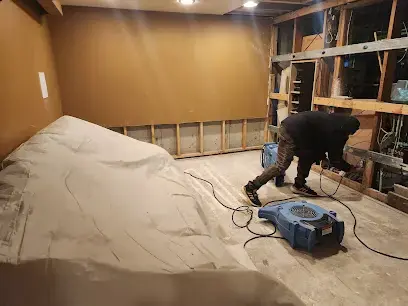
Carpet and pad near the window are usually pulled, since they hold muddy water against the slab. The base of the wall is cut out where the readings show it has soaked up water.
The slab and the framing
Framing at the bottom of the wall and the concrete slab are dried with air movers and dehumidifiers. Water extraction comes first so drying can start on a surface that is not buried in water.
Keeping the next melt out
A little prevention goes a long way here. Spring is the best time to prepare, before the snow melts.
- Clear leaves, dirt and debris from every window well before the snow melts.
- Check that the drain at the bottom of each well is open and not packed with silt.
- Regrade soil so it slopes away from the foundation and the well.
- Fit well covers that fit tightly and shed water instead of collecting it.
- Know where the main shut off valve and the electrical panel are.
Questions
Is window well water clean?
Usually not. It runs across soil and debris on its way in, so crews treat it as contaminated and clean surfaces afterward.
Can a window well flood from only a small amount of snow?
It can if the well is blocked, if the drain is clogged or if the soil slopes toward it. Heavy wet spring snow that melts fast makes this more likely.
Does water from one window mean the whole basement is wet?
Not always, but it can spread under carpet and into wall bases. Moisture readings show how far it went.
Should I run a wet vacuum on a flooded basement floor?
A household wet vacuum will not handle standing water of any depth and may be unsafe near outlets. Call a crew with proper extraction equipment.
What if the window well floods again after the cleanup?
The cause has to be addressed too. Clearing the well, checking the drain at the bottom and regrading the soil away from the foundation all lower the odds of a repeat.