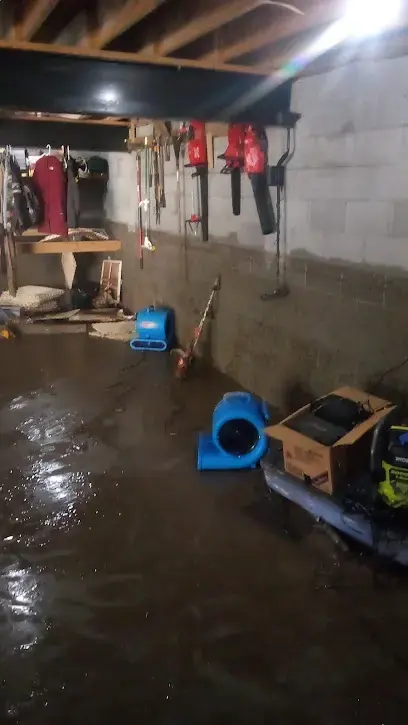
The large tract neighborhoods on Commerce City's northern range, including Reunion, Buffalo Run and Second Creek, were built from the 2000s on. Most of those homes have finished or partly finished basements, which means water below grade lands on carpet, drywall and framing instead of bare concrete.
Key takeaways
- A finished basement holds many more water absorbing materials than an unfinished one, so a small leak has more to damage.
- Expansive clay soils along the Front Range, summer cloudbursts and fast melting spring snow are all local ways water reaches a lower level.
- Standing water comes out first, then wet carpet pad, insulation and the base of the drywall.
- Framing and the slab are dried with meters, not by eye, and drying continues until the readings are dry.
- The sooner water is shut off or pumped out, the less of the finished space has to be removed.
Why finished basements raise the stakes
A basement with a bare concrete floor can often be pumped and dried with little removed. A finished basement is different because the water meets carpet, pad, insulation, drywall and trim.
Reunion, Buffalo Run and Second Creek were built as large tract neighborhoods, and most homes there have finished or partly finished lower levels. That is the housing pattern behind this post.
- Carpet pad soaks up water and holds it against the slab.
- Drywall wicks water upward from the base of the wall.
- Insulation behind the drywall stays wet long after the surface looks dry.
- Framing at the bottom of the walls stays damp unless it is opened and dried.
How water gets into a Commerce City basement
The local climate sends water at a house in several ways. Pinning down the source helps decide how contaminated the water is and what has to be removed.
Storms, cloudbursts and fast snowmelt
The Front Range sees summer hail and cloudbursts, and heavy wet spring snow that melts fast. Both can send more water toward foundations than the ground can take in.
The September 2013 Front Range floods raised the South Platte River through the metro and are a reminder that heavy rain can move a lot of water.
Clay soils that move
Expansive clay soils are common along the Front Range. They swell when wet and shrink when dry, which can open gaps around the foundation where water finds a path.
A newer home is not exempt from this. Soil moves around any foundation, regardless of the year it was built.
Plumbing inside the house
A water heater in a utility closet, a burst supply pipe or an appliance leak above can all send water down to the finished level. Water from a clean source is a much simpler job than water from a drain or sewer.
The first steps for a homeowner
Safety comes before saving belongings. If water is deep or touching outlets, stay out and have the power shut off at the panel by someone who can do it safely.
- Find and close the source if it is plumbing, starting with the supply to the leaking item and then the main shut off valve.
- Shut off power to the basement circuits if the floor is wet and it is safe to reach the panel.
- Lift furniture, boxes and rugs onto higher ground, and do not use household vacuums on standing water.
- Photograph the water level, the walls and the damaged contents.
- Call a restoration crew promptly so extraction can start before the water spreads into the walls.
What gets removed and what gets dried
The job begins with basement flooding cleanup, where standing water is pumped out and the extent of the loss is mapped with moisture meters.
Carpet pad is usually removed because it cannot be dried well in place. Carpet itself can sometimes be lifted, cleaned and saved when the water was clean and was caught early.
- Insulation and drywall at the base of the walls are cut out above the wet area so the cavity can dry.
- Trim and baseboards are taken off and set aside where they can be reused.
- Wet furniture and stored boxes are moved out and dried or discarded.
- Water from sewer or floodwater sources means a larger removal, since porous materials in contact with it are not saved.
Drying the framing and the slab
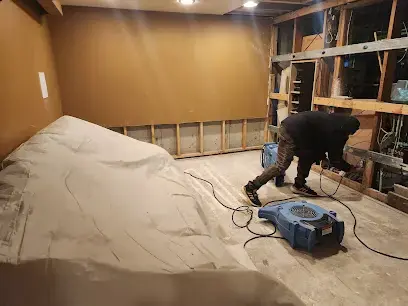
After the wet materials are out, framing and the concrete slab hold moisture that cannot be seen. Dehumidifiers and air movers go in, and readings are logged until the structure matches a dry reference.
Structural drying and dehumidification is the stage that decides whether the finished space can be rebuilt safely, because closing up a wall that is still damp invites further damage.
Why the semi-arid air does not do the job alone
Commerce City's climate is dry, but a lower level is closed off from that air. Wet framing behind drywall and a damp slab need controlled drying to finish properly.
What a drying visit checks
Each visit includes new readings on the wall, the framing and the slab, and equipment is moved or removed as areas reach their goals. Nothing comes out until the numbers say the structure is dry.
Reducing the odds of a repeat
Some steps cost little and help in every neighborhood on the northern range, from Eagle Pointe to Second Creek.
- Keep soil sloped away from the foundation and downspouts discharging well away from the walls.
- Test the basement sump pump or drain if the home has one before the storm season.
- Know the location of the main shut off valve, and make sure every adult in the home does too.
- Do not store items on the floor in a finished basement where a leak could reach them.
- Check the water heater area, the washer and any utility closet for dampness during regular chores.
When water is more than a plumbing problem
If the water came from the sewer, a drain or outdoor floodwater, it is not clean. That kind of loss calls for containment and removal of porous materials, not drying in place.
For water that comes in from storm runoff, see the service pages for water extraction and removal for how crews approach a standing water loss.
Questions
Can finished basement carpet be saved after a flood?
Sometimes. If the water was clean and extraction started early, carpet can often be lifted and cleaned while the pad is replaced. Contaminated water means the carpet goes.
Why cut the drywall if it looks fine above where the water reached?
Drywall wicks moisture upward and holds it in the cavity behind it. Cutting above the wet area lets the cavity dry instead of trapping water against the framing.
How do crews know when the basement is dry?
They take moisture readings on the walls, framing and slab and compare them with a dry reference. Equipment stays until those numbers match.
Are newer homes in Reunion or Buffalo Run safe from basement water?
No home is exempt. Heavy storms, fast snowmelt, soil movement and plumbing failures can all put water on a lower level, whatever the age of the house.
Should I run my own fans and dehumidifier first?
A small fan will not dry wet framing or a slab. It is better to shut off the water, remove what can be moved and let the crew set up measured drying.